Infertility can be one of the most emotionally challenging experiences for any couple. Along with medical treatment, it requires compassion, clarity, and constant support from a trusted specialist. With the right guidance, even the most difficult journey can be transformed into one filled with hope and confidence.
From our very first consultation with Dr. Aindri Sanyal, we felt reassured and understood. Her calm and positive approach immediately gave us confidence and renewed hope. She explained every step of the treatment process in clear and simple terms, ensuring that we were fully informed and comfortable with each decision.
What truly sets Dr. Sanyal apart is her extraordinary availability and dedication to her patients. She is incredibly active and responsive on WhatsApp, replying promptly to queries—even the smallest concerns. This level of accessibility is rare and makes patients feel genuinely supported and safe throughout their fertility journey.
Beyond her medical expertise, Dr. Sanyal’s constant encouragement and empathetic nature made a significant difference. Her positive attitude helped us stay emotionally strong during uncertain moments, while her structured treatment plan kept us focused and confident.
Dr. Aindri Sanyal is not only an excellent infertility specialist but also a wonderful human being. Her commitment, compassion, and patient-centric approach truly make her one of the best infertility specialists in Kolkata, and we are deeply grateful for her guidance and care.
Infertility can be one of the most emotionally challenging phases in a couple’s life. Questions about treatment options, success rates, costs, and timelines—such as IVF how much, in vitro fertilization how much, or whether infertility pills or assisted procedures are needed—often create stress and confusion. In such times, the guidance of an experienced and compassionate fertility specialist becomes invaluable.
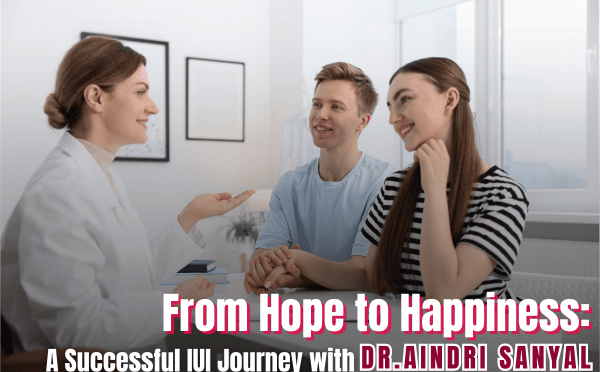
For one grateful couple, that guidance came from Dr. Aindri Sanyal, a renowned fertility doctor known for her expertise in fertility and conception, IVF treatment, and IUI procedures.
After careful evaluation and personalized planning, Dr. Sanyal recommended IUI (Intrauterine Insemination) as the most suitable first step in their IVF journey. From the initial consultation to the procedure itself, she explained every detail clearly—covering treatment expectations, emotional preparation, and next steps if advanced options like IVF, test tube fertilization, or egg donation in IVF were required.
Her patient-centered approach made the journey reassuring rather than overwhelming. And the outcome was joyful—a successful IUI cycle leading to pregnancy.
“Dr. Aindri Sanyal ma’am is truly the best fertility doctor. She gave us success after an IUI, and we couldn’t be happier. Thank you so much, ma’am!” the couple shared.
Dr. Sanyal’s strength lies in offering the full spectrum of infertility therapies, including:
IUI and IVF treatment
In vitro fertilization (IVF) guidance and cost counseling
Egg donation and care for women with low ovarian reserve
Support for fertile women with unexplained infertility
Advanced options like preimplantation genetic testing
Personalized care focused on both medical and emotional well-being
This success story is a reminder that with the right diagnosis, timely treatment, and expert care, the dream of parenthood is achievable.
Snigdha and Santanu had their first baby two years after they go married. It was not an easy pregnancy. Snigdha was diagnosed with hypertension and developed gestational diabetes. She was put under medication and had to be closely monitored through her pregnancy. Fearing complications, the couple opted for a caesarean delivery. Snigdha delivered a healthy baby, and post-delivery, she recovered fast with both her pressure and sugar levels under control. Though there was no reason to be worried with regards to her health, Snigdha was a little troubled by the fact thather periods, after they re-started, had become highly irregular, and would even skip months. But with her mind completely taken up with managing the growing demands of her growing child, she did not pay too much attention to this. When their son Snehashish was two, the couple decided that it was time to have another child. They realised that something was not right when Snigdha failed to conceive even after 6 months of trying.
A visit to an infertility specialist recommended by a friend, brought home the possibility that Snigdha was going through premature ovarian failure.
What is Premature Ovarian Failure?
Premature ovarian failure or primary ovarian insufficiency is a condition that occurs in women below 40 years of age. It occurs when the ovaries do not produce adequate amount of the hormone oestrogen and are unable to release eggs regularly. The condition is different from premature menopause. Though it is potentially possible for a woman going through premature ovarian failure to get pregnant, the condition is largely associated with infertility.
What can cause the condition?
Though it may not be possible to definitely determine the cause, the reasons could range from a genetic disorder to immune system issues. Sometimes it can be a fallout of a medical condition (infection) or lifestyle issues like smoking. A person who had undergone cancer therapies is also more prone to developing premature ovarian failure. Though it normally occurs in women above the age of 35, younger women may also develop the condition. Women who have undergone ovarian surgeries are also likely to develop the condition.
Complications
Infertility is the biggest complication of premature ovarian failure. Though, in rare cases, pregnancy may occur naturally, a woman with the condition is usually unable to conceive naturally. Which does not mean that a woman with the condition cannot get pregnant. Pregnancy is very much possible with assisted reproduction techniques. With the help of In-vitro fertilization a matured egg can be extracted from the ovaries (or a donor egg could be used) and fertilized in a laboratory using the husband/partner’s sperm. A woman undergoing premature ovarian failure is perfectly capable of carrying a child and delivering a normal, healthy baby.
Apart from infertility, a woman with premature ovarian failure is at greater risk of osteoporosis (due to less production of oestrogen), heart disease and depression.
Can the condition be treated?
Treatment for the condition depends largely on the complications arising from it. Since oestrogen deficiency is the cause of symptoms like hot flashes and increased risk of osteoporosis, oestrogen therapy is recommended, along with the hormone progesterone. The therapy is likely to regularize your periods, but cannot restore ovarian function. Though the hormone therapy can be continued till the age of natural menopause (50-51), it has been seen to be more beneficial in younger women.
Calcium and Vitamin D supplements are also recommended for preventing osteoporosis.
Though premature ovarian failure does not usually display any obvious symptoms, a visit to a doctor is recommended if you are not at a menopausal age and experiencing pre-menopausal symptoms, and irregular or missed periods.
As women, we all go through different life
stages that bring with them their own sets of complications, a large number of
them related to our physical and mental health and well-being. Every year on
International Women’s Day, the focus of the world turns on the fairer sex, and
all around us we start hearing talk about gender equality and woman power. We
are recognised as ‘achievers’ in various forums, showered with gifts and
awards. While all of this makes us feel special and cared for, it is important
to remember that a woman’s health is not about a day in a year, it is about a
lifetime.
Puberty
To understand the complexities of a woman’s
health status, it is important to understand the stages in a woman’s life. The
first stage begins as she steps from childhood into Puberty. With puberty come the
periods – the first indication of the hormonal changes taking place in a
woman’s body. Beginning of menstruation is a big change in a woman’s life
cycle, as she struggles to make a host of physical and mental adjustments. The release
of the hormone Oestrogen in the ovaries are responsible for the sexual
development that happens at this stage of life. The hormonal changes often have
other manifestations including:
Unexplained mood swings
Low self esteem
Aggression
Depression
Sprouting of Acne
Excess hair growth on the body
Sudden weight gain
Menstruation may also sometimes bring with
it additional woes like irregular and/or painful periods, heavy bleeding. If
the discomfort becomes difficult to manage, then it is advisable to visit a
doctor and go for check-ups recommended to rule out certain medical conditions
like ovarian cysts or polycystic ovaries – a condition caused by hormonal
imbalance.
Hormonal imbalance is also often
responsible for infertilityin women of child
bearing age, as it can result in disorders like PCOS or anovulation (a
condition where the ovaries do not ovulate as required).
Pregnancy
The second stage in a woman’s life arrives
when she conceives. The hormonal changes that she experiences during this
period can again bring about bouts of depression and severe mood swings. The
hormonal changes are essential for the development of the foetus, but in the
mother, it can cause complications like:
Morning sickness
Blurry vision
Disturbed sleep
Back pain
Loss of sensations of taste or
smell
Some women may experience hormonal
imbalance that can cause more serious complications like gestational diabetes,
preeclampsia, even miscarriage if not addressed in time. During the postpartum period, a woman’s body again
undergoes changes as the hormone levels go back to normal. A new mother can
experience a plethora of emotions from extreme happiness to complete exhaustion
or even depression. As your body heals from the trauma of childbirth, your mind
too struggles to come to terms with a new role and new responsibilities. The
support of your partner and family is extremely important during this period. If,
however, you experience chronic depression and have thoughts of harming
yourself, you must consult your doctor as you could be suffering from a
clinical condition called post-partum depression.
Menopause
The third main stage in a woman’s life
occurs around the age of 45-50, when she goes through menopause. This is when her
menstrual cycle stops. Preceding this some woman may experience a period of
various discomforts including:
Irregular periods
Hot flashes
Vaginal dryness
Night sweats
Sleep problems
Mood swings
Weight gain
It is important to stay in touch with your
doctor during this period. You may need some medical interventions like hormone
replacement therapy if your symptoms are severe and difficult to manage. Your
doctor may recommend some health screening tests post menopause, as this is the
time when a woman becomes more susceptible to medical conditions like
osteoporosis, heart disease, thyroid disorders, and sleep disorders.
It is important to understand that hormonal
changes during the different stages in a woman’s life are normal, hormonal
imbalances, however, are not and need to be addressed. Do visit a doctorif you
experience any symptoms that suggest an imbalance, as it can have long-term
consequences on your physical as well as mental health.
The World Health Organization (WHO), which has been working in the domain of sexual health since 1974, defines sexual health as “a state of physical, emotional, mental and social well-being in relation to sexuality; it is not merely the absence of disease, dysfunction or infirmity. Sexual health requires a positive and respectful approach to sexuality and sexual relationships, as well as the possibility of having pleasurable and safe sexual experiences, free of coercion, discrimination and violence.”
WHO’s lucid definition is extremely significant as research over the decades has revealed that sexual health is intertwined with both physical health and mental well-being. So, while stress, anxiety or depression can lead to sexual health issues, it’s equally true the other way round. The benefits of investing in sexual and reproductive health are measurable and impactful and hence can’t be overemphasized.
What are the key elements defining sexual health?
Looking at the big picture, these are the core clauses that define and constitute sexual health:
# It’s about overall well-being, not merely the absence of a medical condition
# It stands on the 3 pillars of respect, safety and zero tolerance to discrimination and violence
# It’s defined by the guarantee of certain human rights
# It’s significant, not only during one’s reproductive years, but the entire lifespan
# There can be different forms of sexual expression and diverse sexuality
# Gender disparity and power dynamics play a critical role in a person’s sexual health, more so in the developing world
This inevitably brings us to the issue of sexual rights. The civilized world now accepts that without ensuring certain human rights, sexual health for all is not achievable.
So, what are the rights critical to ensuring sexual health?
# Right to not be discriminated against on any grounds
# Right against cruelty or being subjected to torture or other inhuman acts
# Right to privacy
# Right to be protected by the social security net and to be sexually and otherwise healthy
# Right to tie the knot in the spirit of equality and to have a family with free and full consent of the spouses, as well as separation with mutual consent
# Freedom to determine the number and spacing of children
# Right to education and information
# Right to express oneself freely and without fear
# Right to justice if any fundamental right is violated
How critical is information and education?
Information and education are pivotal to robust sexual and reproductive health. It’s critical to be educated on the risks and perils of sexually transmitted infections (STIs). Also, whenever a couple decides on having a family, the healthcare system must ensure access to critical services that can ensure a hassle-free pregnancy, safe delivery procedure and good health for the newborn.
In a developing country like India, reproductive health issues are a major cause of serious complications and mortality of women during childbearing age. The misery is often exacerbated by unintended pregnancies, botched-up abortions, sexually transmitted infections and domestic violence.
It is important to understand that sexual health is directly linked to one’s reproductive health.
Women, in particular, are likely to suffer from different sexual health issues during different phases of their life-cycle – from attaining puberty to the onset of menstruation, first sexual intercourse to pregnancy, and, sometimes due to chronic conditions like endometriosis, PCOSand STIs. These are all likely to impact their reproductive health. Awareness regarding menstrual hygiene, contraception, health conditions, screening (cervical/STIs) and vaccination (HPV) options available is of vital importance in this scenario.
Why is menstrual hygiene important?
Lack of menstrual hygiene can lead to infections in the reproductive (RTIs) and urinary tract (UTIs). Recurrent RTIs can adversely impact one’s reproductive health, including difficulty in conceiving and complications during pregnancy (pre-term delivery, increased risk of miscarriage. Frequent UTIs can increase risk of kidney failure in the long run.
The role of contraception in reproductive health is important.
When it comes to reproductive health, a girl’s age becomes a major factor. Pregnancy before attaining adulthood can be detrimental to the health of not just the young mother, but also the child. Awareness about the importance of contraception and various contraceptive methods available plays a large role in not only preventing underage pregnancies, but also in healthy pregnancy at the right age and right time.
Over the past few decades, the world has taken giant strides in areas relating to sexual and reproductive health rights like maternal and newborn health, safe contraception and HIV/AIDS. However, rather lamentably, in much of the developing world, people still have inadequate access to sexual and reproductive health services, often, none at all.